Argument: An argument is an expression which is passed to a function by its caller (or macro by its invoker) in order for the function(or macro) to perform its task. It is an expression in the comma-separated list bound by the parentheses in a function call expression.
Actual arguments:
The arguments that are passed in a function call are called actual arguments. These arguments are defined in the calling function.
Formal arguments:
The formal arguments are the parameters/arguments in a function declaration. The scope of formal arguments is local to the function definition in which they are used. Formal arguments belong to the called function. Formal arguments are a copy of the actual arguments. A change in formal arguments would not be reflected in the actual arguments.
Example:
#include<stdio.h>
void sum(int i, int j, int k);
  /* calling function */
  int main() {
    int a = 5;
    // actual arguments
    sum(3, 2 * a, a);
    return 0;
  }
  /* called function */
  /* formal arguments*/
  void sum(int i, int j, int k) {
    int s;
    s = i + j + k;
    printf("sum is %d", s);
  }
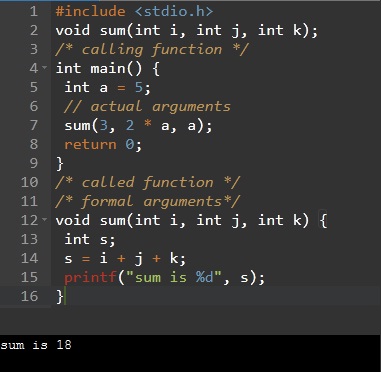
Here 3,2*a,a are actual arguments and i,j,k are formal arguments.
 Dinesh Thakur holds an B.C.A, MCDBA, MCSD certifications. Dinesh authors the hugely popular